
Breast Augmentation Surgery

Natural Proportion and Symmetry in Breast Augmentation
Breast augmentation surgery is one of the aesthetic surgical procedures considered for people who have developmentally small breasts, experience volume loss after pregnancy or weight changes, or want to reduce the volume difference between the two breasts. The operation does not only focus on increasing breast size; it also aims to create a balanced form in harmony with the rib cage, breast base, existing tissue, skin structure and overall body proportions.
In evaluations performed by Prof. Dr. Osman Kelahmetoğlu, implant volume is not considered alone. Shoulder width, torso structure, thickness of breast tissue, nipple position, differences between the two breasts, lifestyle and expectations are evaluated together to create a personalized surgical plan.
What Is Breast Augmentation Aesthetics?
Breast augmentation aesthetics, or augmentation mammoplasty, is a surgical procedure performed to increase breast volume, restore fullness loss in the upper breast area, balance developmental smallness or reduce natural asymmetry. Augmentation is most commonly performed with breast implants. In suitable patients, when a limited volume increase is targeted, fat injection using the person’s own fat tissue may also be considered.
The goal of this operation is not to create the same size or the same breast shape in everyone. Breast base width, the forward and lateral structure of the rib cage, skin elasticity, the thickness of existing breast tissue and the person’s desired appearance are considered together. A natural appearance does not only mean choosing a small implant. The correct width, projection, placement level and soft tissue coverage must be compatible with the person’s anatomy.
Volume Increase
The aim is to make breast volume more balanced with the torso structure and to adjust upper pole fullness to a suitable degree for the person.
Shape and Symmetry
Natural differences between the two breasts are evaluated, and the implant and surgical technique are planned for the most balanced form possible.
Breast augmentation is not only about “how many cc?”
Although implant volume is important, the implant’s base width, profile, shape, anatomical plane of placement and how much the existing breast tissue covers the implant are also determining factors in the result.
In Which Situations May Breast Augmentation Surgery Be Considered?
Breast augmentation surgery may be considered in the following situations according to the person’s physical characteristics and expectations:
- Developmentally small or insufficient breast volume
- Loss of breast volume after pregnancy, breastfeeding or weight loss
- Noticeable loss of fullness in the upper breast area
- Congenital or acquired volume difference between the two breasts
- Desire for a breast volume that is more balanced with the rib cage and overall body proportions
- Need for volume and form adjustment in developmental shape differences such as tubular breast
- Need for revision related to the size, position or shape of a previously placed implant
Age alone does not determine the decision for surgery. Completion of breast development, suitability of general health status, realistic expectations and the person’s own decision are important. For more detailed information on this subject, you can review the informational content titled the best age for breast aesthetics.
Suitability is determined through examination
Active infection, uncontrolled health problems, pregnancy or breastfeeding period, heavy smoking or unrealistic expectations may affect the surgical plan. Each person’s health status should be evaluated separately.
Personalized Evaluation Before Breast Augmentation
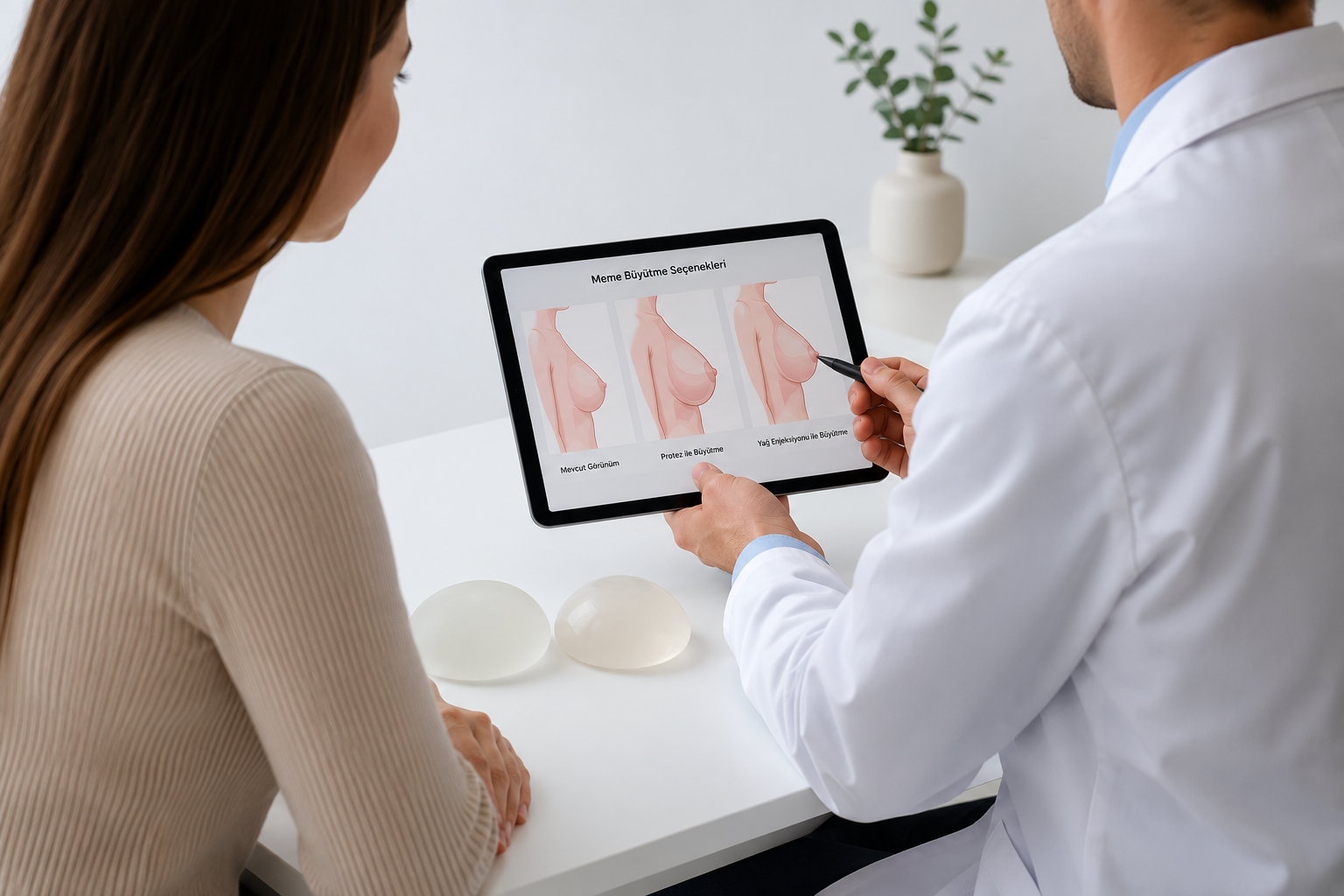
A successful breast augmentation plan cannot be created only by evaluating a visual the patient likes or a desired bra size. During examination, the current volume of the breasts, base width, nipple level, inframammary fold, skin quality, soft tissue thickness and rib cage structure are examined.
If there is a difference in volume, base or nipple level between the two breasts, the source of this difference is determined. When necessary, implants with different volumes or profiles may be considered for each side. However, since there is no perfect mathematical equality in the human body, the aim is not flawless sameness, but a more balanced appearance that reduces existing differences within safe limits.
Anatomical Measurement
The breast base, rib cage width, nipple position and distance between the two breasts are measured.
Tissue Analysis
The thickness of existing breast tissue, skin elasticity and adequacy of soft tissue coverage over the implant are evaluated.
Expectation Discussion
The person’s expectation for a natural, noticeable, fuller or more limited change is compared with the results that can be achieved anatomically.
Health Evaluation
Medications used, previous surgeries, smoking, pregnancy plans and personal or family history of breast disease are addressed.
How Is a Breast Implant Selected?
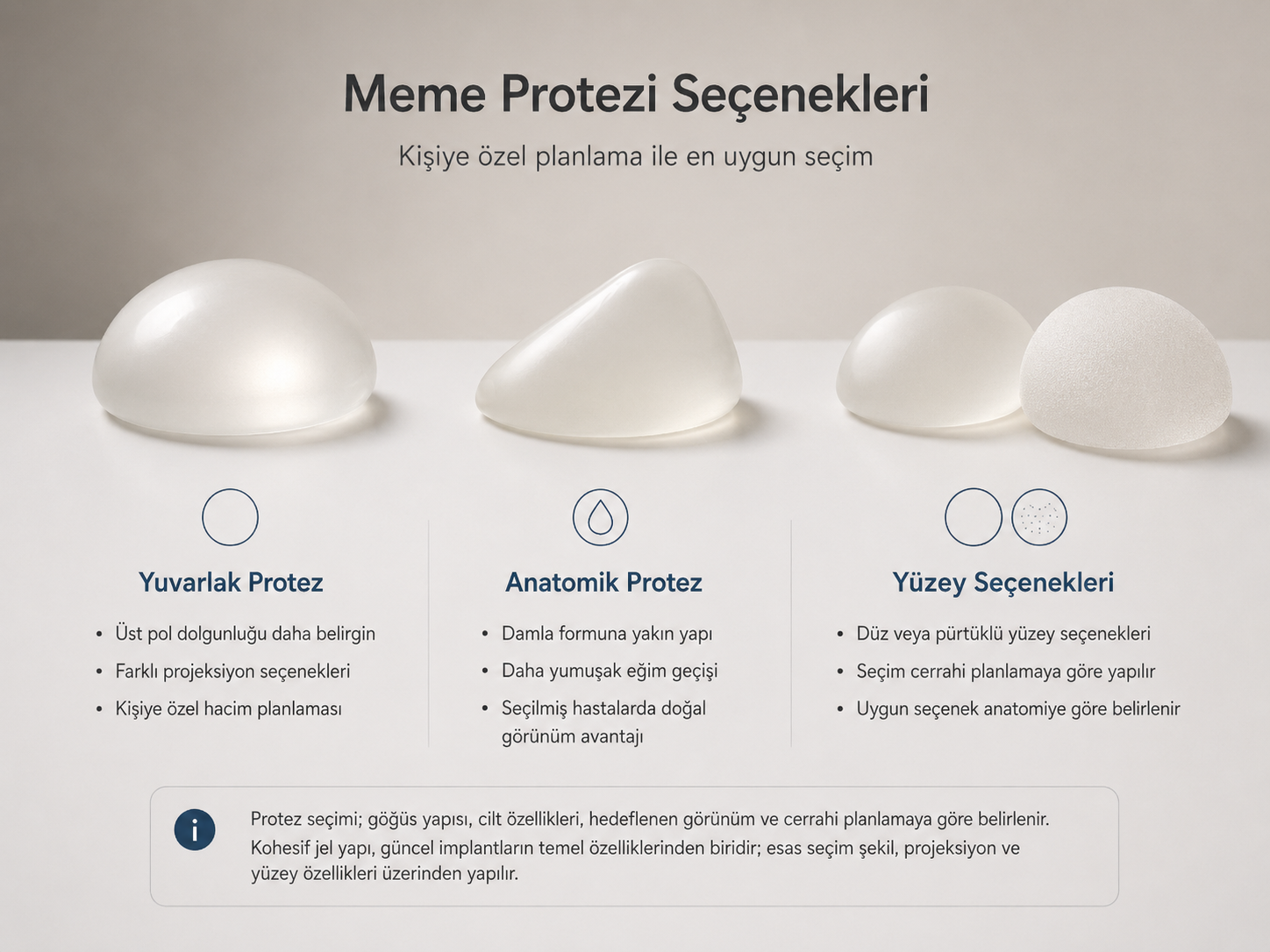
Breast implant selection is made by evaluating not only the implant volume, but also width, height, profile, shape, filling and surface characteristics together. Two implants with the same volume may have different base widths and different forward projections. Therefore, an implant used in another person should not be expected to provide the same result.
Round Implants
They may be considered when more noticeable upper breast fullness is desired or when the person’s anatomy is suitable. The result depends not only on the implant shape, but also on the placement plan and existing tissue.
Anatomical Implants
They have a teardrop-like form that provides more volume distribution in the lower part. Suitability is determined according to breast structure, tissue thickness and the targeted appearance.
What does implant profile mean?
Profile refers to how much the implant projects forward from the chest wall relative to its base width. The decision between low, moderate or high profile options is not made only according to the desire for a more prominent appearance. A profile that is not compatible with the width of the rib cage and the measurement of the breast base may go beyond natural limits or create unnecessary pressure on soft tissue.
How is implant volume determined?
Implant volume is expressed in cubic centimeters (cc); however, the same cc does not create the same bra size or the same appearance in every body. Breast base, existing breast tissue, torso length and implant profile all affect the result together. Therefore, the final choice is made after examination, measurement and surgical planning.
Is a Breast Implant Placed Under or Over the Muscle?
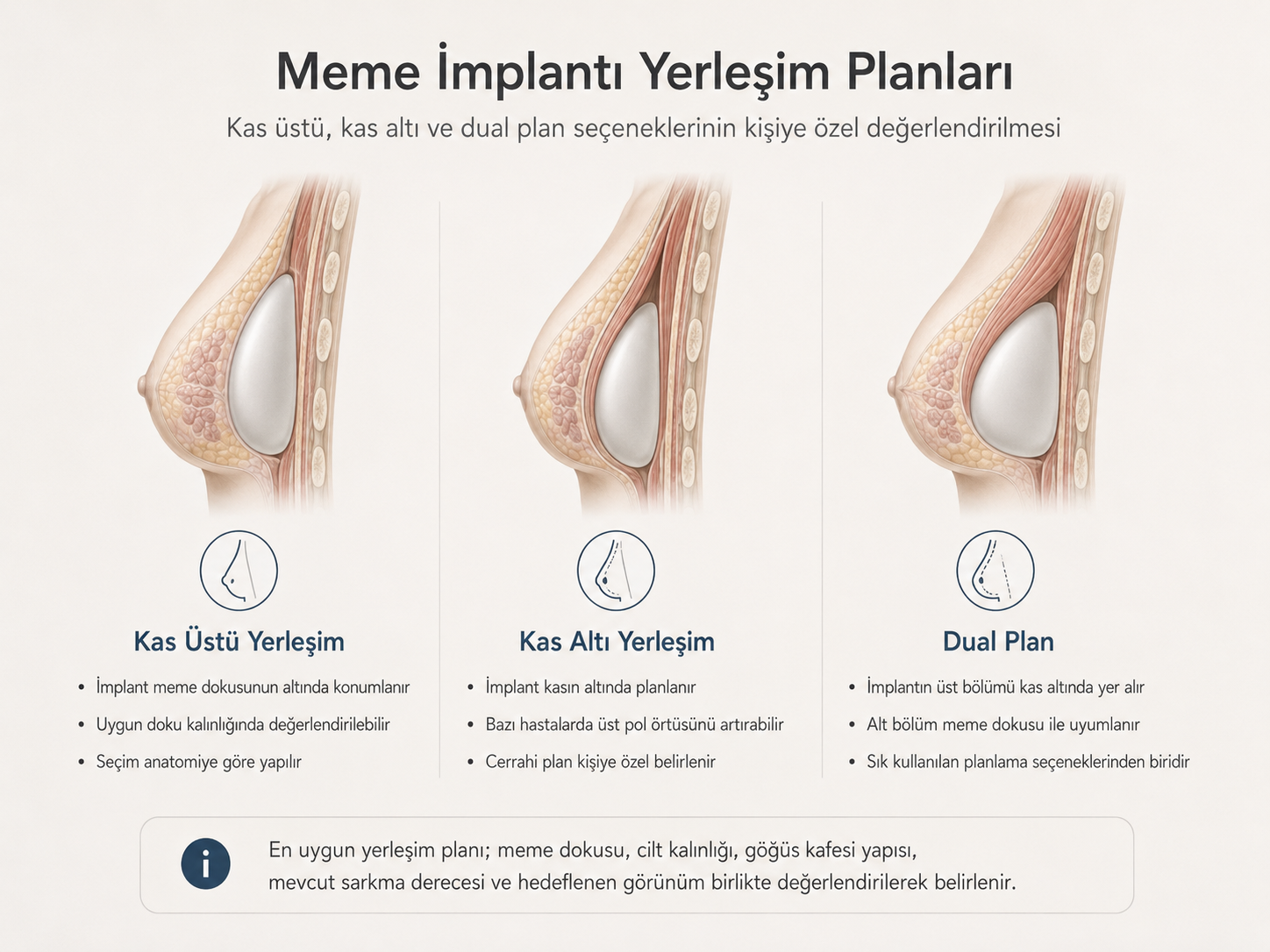
A breast implant may be placed under the breast tissue, under the muscle fascia, under the pectoral muscle or at the dual-plane level. There is no single “best” placement level that applies to every patient. The decision is made according to the thickness of existing breast tissue, skin structure, implant characteristics, the person’s physical activity level and the targeted breast form.
Under the Breast Tissue
The implant is positioned under the breast tissue and above the pectoral muscle. It may be considered in suitable patients with adequate soft tissue coverage.
Under the Muscle Fascia
This is the plane where the implant is placed under the fascia layer covering the pectoral muscle. Suitability is evaluated according to tissue structure.
Under the Muscle
This means that part or all of the implant is positioned under the pectoral muscle. In patients with thin tissue, it may contribute to covering the upper part of the implant.
Dual Plane
This is a combined placement approach in which the upper part of the implant is covered by muscle and the lower part by breast tissue.
The placement plan may affect the result and recovery process
Implant visibility, possible shape change during movement, upper pole transition and early tightness sensation may differ according to the selected anatomical plane. Advantages and limitations should be discussed individually during examination.
How Is the Incision Site Determined in Breast Augmentation Surgery?
Different incision areas such as the inframammary fold, around the nipple or the armpit may be used to place the implant. Incision selection is made by considering the type and size of the implant, breast anatomy, previous surgeries, scar placement and the surgeon’s need for safe access.
Inframammary Fold
This is an incision made along the natural fold under the breast. It may allow the implant pocket to be prepared under direct visualization and the inframammary fold to be planned in a controlled manner.
Around the Nipple or Armpit
Alternative incision areas may be considered in suitable patients. Each approach has different limitations in terms of tissue access, scar location and technique.
Every surgical incision leaves a scar. The goal is not for the scar to disappear completely, but for it to be placed along an appropriate anatomical line, for the tissues to be handled with as little trauma as possible and for it to become less noticeable over time with proper postoperative care.
Breast Augmentation or Breast Lift?
Breast augmentation surgery increases volume and projection; however, it is not always sufficient on its own to correct noticeable sagging. If the nipple has descended below the inframammary fold, excess skin is noticeable or the breast tissue has shifted downward, breast lift surgery may be required.
In people with both volume loss and sagging, implant and lift may be combined within the same surgical plan. On the other hand, if existing breast volume is sufficient and the main problem is only positional loss, a lift without an implant may also be possible. The decision is based on evaluating the expectation of “larger or lifted?” together with anatomical findings.
If the Main Problem Is Volume Loss
If the nipple is at an appropriate level and excess skin is limited, augmentation with an implant alone may be sufficient.
If Sagging Accompanies Volume Loss
Augmentation and lift may be considered together to reshape breast tissue and remove excess skin.
To review the differences between the two operations in more detail, you can use the content titled breast lift or breast augmentation? For a general approach where breast augmentation, reduction and lift options are considered together, you can review the breast aesthetics page.
Breast Augmentation with Fat Injection
In breast augmentation with fat injection, fat tissue taken by liposuction from suitable areas such as the abdomen, waist, hips or thighs is processed through special procedures and then injected into the breast area in controlled layers. The main difference of this method is that no foreign implant is used.
Fat injection may generally be considered in people who want a limited and softer volume increase and have enough donor fat in their body. Not all of the injected fat may be permanent; some of it may be absorbed by the body during the healing process. It should be known that more than one session may be required depending on the targeted volume and that the noticeable volume increase achieved with implants may not be achieved with fat injection in every person.
Implant and fat injection are not exact equivalents of each other
While an implant may provide a more predictable and noticeable volume increase, fat injection has features such as more limited volume, the need for sufficient donor fat and a variable retention rate. Which method is suitable is determined according to the person’s expectation and anatomy.
Evaluate the implant and surgical plan suitable for your breast structure together
Implant volume, shape and placement plan can only be determined individually after anatomical measurement and examination. You can create an evaluation appointment at the clinic in Istanbul Şişli.
How Is Breast Augmentation Surgery Performed?
Breast augmentation surgery is performed in a hospital setting and mostly under general anesthesia. The surgical plan is reviewed one last time in line with the measurements made before surgery; the incision line, inframammary fold and the area where the implant will be placed are marked.
Entering through the selected incision area, an appropriate anatomical pocket is prepared for the implant. After bleeding control is achieved, the planned implant is placed and the height, volume and fold relationship between the two breasts are evaluated. When necessary, small planning differences may be rechecked during surgery. The incisions are closed according to anatomical layers and dressing is applied.
1. Surgical Marking
The breast midline, existing inframammary fold, planned new borders and asymmetry points are determined.
2. Preparation of the Implant Pocket
The selected subglandular, submuscular or dual-plane area for the implant is created in a controlled manner.
3. Placement of the Implant
The implant suitable for the measurements is placed, and breast form and balance between the two sides are checked.
4. Closure and Follow-Up
The incisions are closed in layers, dressing is applied and the postoperative follow-up plan is started.
The operation time may vary depending on the technique applied, accompanying asymmetry correction, implant exchange or whether an additional procedure such as a lift is performed. Hospital stay and discharge decisions are also made according to personal health status and the scope of the operation.

Recovery Process After Breast Augmentation
In the first days after surgery, tightness, pressure sensation, swelling and temporary limitation in movement may be seen in the chest area. Especially when the implant is placed under the muscle, more tightness may be felt during movements that use the chest muscle. Regular use of prescribed medications and adherence to the follow-up plan are important.
First Days
Rest, short walks, protection of wound care and avoiding sudden movements that strain the arms are prioritized.
First Weeks
Return to daily life varies from person to person. Heavy lifting, intense exercise and movements that strain the upper body should not be started without doctor approval.
It may be necessary to use a medical bra for the recommended period after surgery. Sleeping position, showering, driving, return to work and the time to start sports are explained individually according to the scope of the surgery performed. Since smoking negatively affects wound healing, stopping smoking before and after surgery is important.
The appearance in the first weeks is not the final result. Reduction of swelling, adaptation of the implant to the planned position and softening of tissues take time. The healing pace of the two breasts may not be the same; mild level or firmness differences seen in the early period may change during follow-up.
Will There Be Scars After Breast Augmentation?
A surgical incision is required to place the breast implant, and every incision leaves a permanent scar. The scar may be located in the inframammary fold, around the nipple or in the armpit. Scar length and visibility may vary according to the technique used, implant size, skin characteristics, genetic tendency, smoking and wound care.
Scars may appear pink, firm or raised in the early period. During the maturation process, they mostly soften and their color fades; however, they should not be expected to disappear completely. If the person has a tendency to form scars, silicone-based products, sun protection or different scar treatments may be considered at the appropriate time.
Possible Risks of Breast Augmentation Surgery
As with every surgical procedure, breast augmentation surgery carries risks such as bleeding, infection, fluid accumulation, delayed wound healing, anesthesia-related problems, noticeable scarring, pain, sensory changes and undesired differences between the two breasts.
In operations using implants, implant-specific conditions may also occur, such as capsular contracture, implant displacement or rotation, feeling the implant edges, rippling appearance, change in the inframammary fold, loss of implant integrity and the need for additional surgery in later years.
Capsular Contracture
This is the hardening of the natural capsule tissue formed by the body around the implant, causing tightness, shape change or pain in the breast.
Loss of Implant Integrity
Different situations may occur, including deflation in saline-filled implants and silent rupture without symptoms in silicone gel implants.
Changes in Position and Symmetry
The implant moving downward, sideways or in a different direction may affect breast shape and balance between the two sides.
Rare Implant-Related Conditions
The rare lymphoma type called BIA-ALCL has been associated especially with certain textured-surface implants. If persistent swelling, fluid accumulation, a mass or pain occurs in the late period, evaluation is required.
An informed decision requires discussing not only benefits but also limitations
The characteristics of the implant to be used, expected change, possible risks, alternative methods and the possibility of additional surgery in the future should be clearly evaluated before surgery.
Can Breast Implants Be Used for a Lifetime?
Breast implants are not devices guaranteed to be used for a lifetime without any follow-up. However, there is also no single rule that applies to everyone stating that an implant without any problems must automatically be replaced only because a certain number of years has passed. The decision for replacement is made according to complaints, examination findings, imaging results, implant condition and the person’s expectations.
In silicone gel implants, loss of integrity may sometimes show no external symptoms. Therefore, regular clinical follow-up and, when considered necessary, ultrasound or magnetic resonance imaging may be used. Keeping the device card containing the implant’s brand, model and serial information is important for follow-ups in later years.
In which situations should follow-up not be delayed?
- New or gradually increasing firmness in the breast
- Unilateral and persistent swelling or noticeable volume change
- Newly developed pain, mass or fluid sensation
- Noticeable change in breast shape, implant position or inframammary fold
- Suspicion about implant integrity after trauma
Pregnancy, Breastfeeding and Breast Screening
Pregnancy is possible after breast augmentation surgery. However, pregnancy, breastfeeding, weight change and aging may affect breast skin and natural breast tissue; therefore, the form achieved with surgery may change over time. In people planning pregnancy in the near future, the timing of surgery should be evaluated separately.
The possibility of breastfeeding may vary according to the person’s preoperative milk production capacity, the incision and surgical technique used, and the degree to which breast tissue and milk ducts are affected. It is important for people with future breastfeeding plans to share this expectation during examination.
People with breast implants should continue routine breast health checks appropriate for their age and personal risk status. Before mammography or other imaging procedures, the technician and relevant physician should be informed that an implant is present. Implant follow-up and breast cancer screening have different purposes and are planned individually.
Are Aesthetic Breast Augmentation and Breast Reconstruction the Same Procedure?
Aesthetic breast augmentation aims to adjust the volume and form of existing breast tissue according to the person’s expectations. Breast reconstruction, performed after cancer surgery, trauma, congenital difference or significant tissue loss, is a reconstructive process aimed at recreating lost tissue.
Although implants may be used in both areas, the surgical purpose, existing tissues and planning are different. Reconstructive surgery may sometimes require flap methods using the person’s own tissue in addition to an implant, or more than one staged operation.
Why Prof. Dr. Osman Kelahmetoğlu?
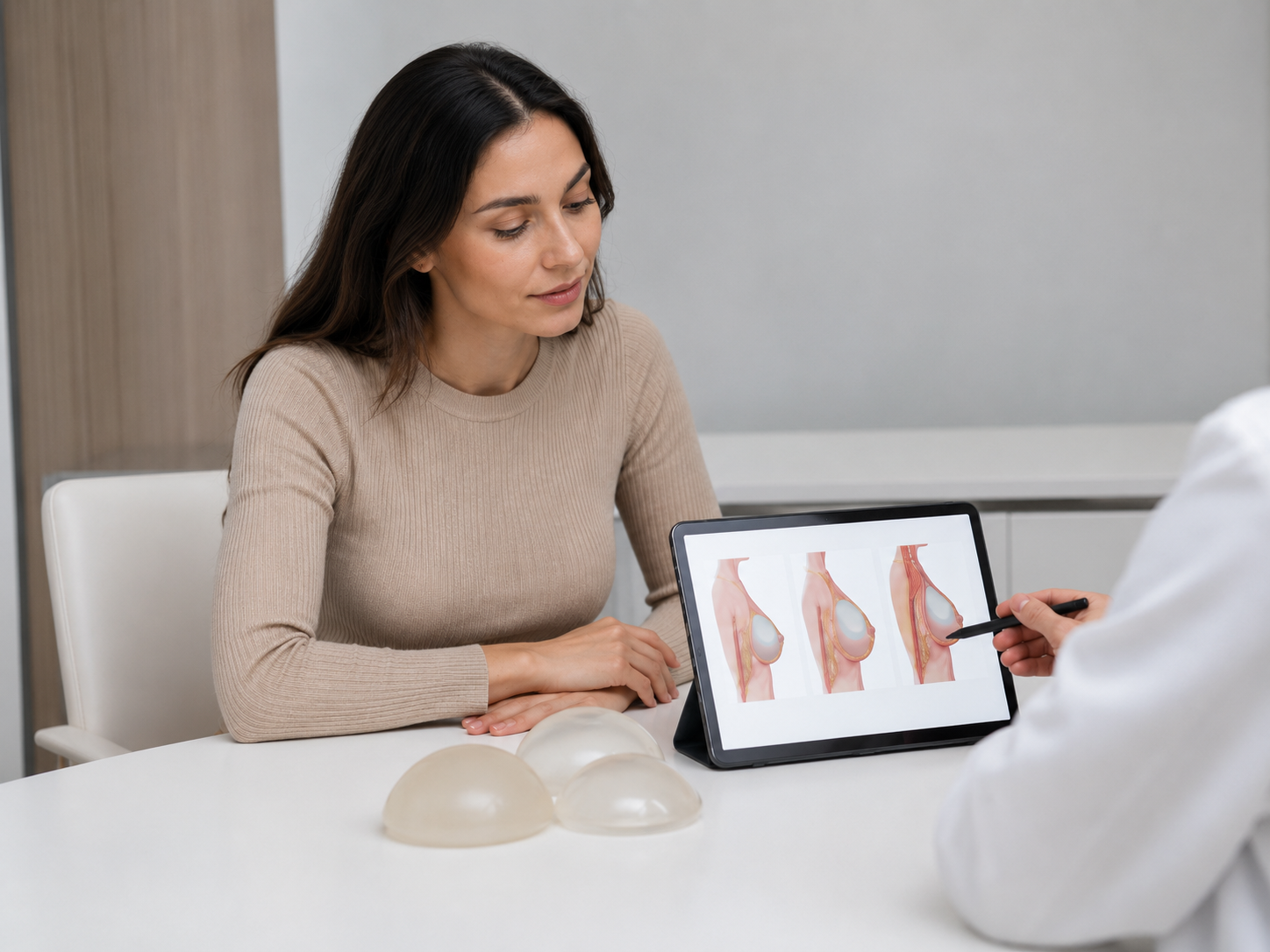
Breast augmentation surgery requires evaluating not only implant volume selection, but also the anatomy of breast tissue, blood circulation, rib cage structure, inframammary fold, possible asymmetries and the long-term behavior of tissues together.
Prof. Dr. Osman Kelahmetoğlu’s academic and clinical experience in plastic, reconstructive and aesthetic surgery contributes to considering aesthetic goals together with tissue safety, anatomical limits and personalized planning. His academic publications, invited talks, educational roles and professional work can be found on the scientific studies page.
Personalized Measurement and Planning
Implant width, profile, volume, incision site and placement level are determined separately according to the person’s breast structure.
Aesthetic and Reconstructive Perspective
Breast form is evaluated not only in terms of size, but also in terms of tissue integrity, symmetry, scar placement and long-term changes.
Breast Augmentation Surgery Prices in Istanbul
Breast augmentation surgery prices in Istanbul may vary according to the characteristics of the implant to be used, surgical technique, implant placement plan, whether an additional procedure such as asymmetry correction or breast lift is required, hospital conditions and the personalized treatment plan.
Since every patient’s breast structure and needs are different, it is not correct to determine a standard operation plan and exact price only by phone or message. After examination, implant selection, scope of surgery, hospital process, follow-ups and possible additional procedures are clarified, and personalized information is provided.
Compare the scope of the operation as much as the price
When making an evaluation, the implant brand and characteristics, the hospital where the surgery will be performed, anesthesia process, surgical follow-up and whether postoperative controls are included in the planning should be considered together.
Frequently Asked Questions About Breast Augmentation
How many cc implants are used in breast augmentation surgery?
Implant volume is not determined only according to the desired bra size. Breast base, rib cage, existing tissue thickness, implant profile and targeted appearance are evaluated together. The same cc may create different results in different people.
Do round or anatomical implants look more natural?
A natural appearance does not depend only on implant shape. Implant width, profile, placement level and the thickness of breast tissue covering the implant are all effective together. The suitable option is determined through examination.
Does breast augmentation surgery correct sagging?
In limited skin laxity, an implant may provide some fullness; however, if there is noticeable sagging, augmentation alone may not be sufficient. Breast lift or augmentation with lift may be considered together.
Should a breast implant be placed under the muscle?
Submuscular placement is not mandatory or the only correct option for every patient. Subglandular, subfascial and dual-plane options may also be evaluated according to the person’s tissue thickness, lifestyle and targeted result.
When can I return to work after breast augmentation?
The time to return to work varies according to the physical intensity of the job, implant placement and the person’s recovery speed. Returning to desk work and returning to heavy physical work are not the same; individual timing is determined during follow-ups.
When can sports be done after breast augmentation?
Short walks may be allowed in the early period; however, weight lifting, running and exercises that strain the upper body should not be started without doctor approval. The duration varies according to the surgical technique.
Can breast implants rupture?
Loss of integrity may occur in the outer shell of the implant over time or due to causes such as trauma. While deflation is more easily noticed in saline-filled implants, silent rupture may be seen in silicone gel implants. Imaging is performed if there is suspicion.
Are breast implants replaced every 10 years?
There is no rule that applies to everyone stating that every implant must automatically be replaced in the 10th year. Implants are not lifetime devices; the decision for replacement is made according to complaints, examination, imaging and implant condition.
Can breastfeeding be possible after breast augmentation?
Many people can breastfeed after surgery; however, breastfeeding capacity may vary according to preoperative characteristics and the technique used. People planning pregnancy in the future should share this during examination.
When does the breast augmentation result settle?
The volume change is visible immediately after surgery; however, reduction of swelling, adaptation of the implant to its position and softening of tissues occur over weeks to months. The final appearance should not be evaluated in the early period.
Is it possible for the two breasts to be exactly the same?
Natural asymmetries exist in the human body. Noticeable differences may be reduced with surgery; however, it cannot be guaranteed that the two breasts will be mathematically identical.
Is a drain used in breast augmentation surgery?
Drain use may vary according to surgical technique, implant pocket, bleeding control and accompanying procedures. It may not be routinely necessary in every patient; the decision is made during surgery.
Medical Information and Content Currency
This page has been prepared for general informational purposes about the scope of breast augmentation surgery, planning process, alternatives and possible risks. The information here does not replace personal examination, diagnosis or treatment recommendation. The appropriate surgical method can only be determined after physical examination and health evaluation.
Last update: September 10, 2026
Contact and Examination Appointment
To get detailed information about breast augmentation surgery, evaluate implant options suitable for your breast structure and create a personalized surgical plan, you can contact Prof. Dr. Osman Kelahmetoğlu’s clinic in Istanbul Şişli / Nişantaşı.
During examination, your expectations, anatomical measurements, implant options, scope of surgery, recovery process, possible risks and long-term follow-up plan are evaluated according to your personal condition.
Personalized breast augmentation planning in Istanbul Şişli
You can create an appointment for a breast augmentation evaluation that considers natural appearance, long-term tissue health and compatibility with your body proportions.