
Dangerous Moles: Melanoma Symptoms And Early Diagnosis
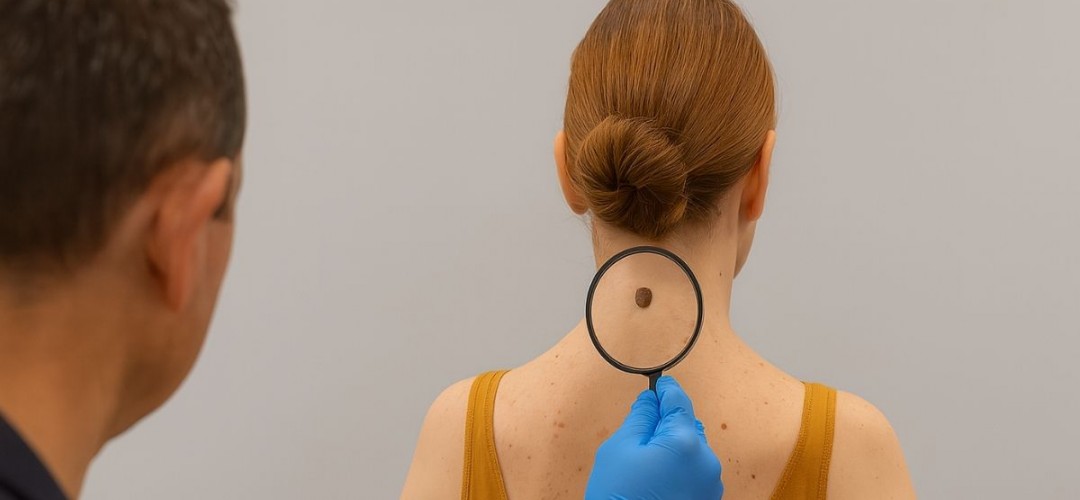
When Are Moles on the Skin Dangerous? Signs of Melanoma Risk
Moles (nevi) are generally innocent skin formations created by a collection of cells called melanocytes, which give color to the skin. Most people have an average of 10–40 moles, which appear starting from childhood and can increase in number until around the age of 40. The vast majority are benign, meaning they do not pose a serious health risk. However, some moles can be a warning sign for the development of a malignant skin tumor (melanoma) over time.
For this reason, noticing changes in color, shape, border, size, and behavior in moles and consulting a specialist when necessary is of vital importance.
What is a Mole (Nevus)? What Does a Normal Mole Look Like?
General Characteristics of Moles
Normal, benign moles are usually:
- Round or oval in shape,
- Monochromatic (light brown, dark brown, or close to skin tone),
- Have distinct borders with a clear transition from the surrounding skin,
- Grow slowly and may show very slight changes over the years,
- Do not cause complaints such as itching, bleeding, crusting, or pain.
Up to What Age Can New Moles Appear?
The majority of moles appear during childhood and youth. The formation of new moles is considered normal up to the age of 40. However, any new spot appearing after age 40 or noticeable changes in an existing mole must be evaluated by a specialist.
Dangerous Moles: Symptoms Indicating Melanoma Risk
Moles can, albeit rarely, turn into a malignant skin cancer called melanoma. Melanoma is a tumor that has a high chance of treatment when caught early but can follow an aggressive course when diagnosed late. Therefore, we use the ABCDE rule, a simple but important method, when evaluating moles.
Mole Control with the ABCDE Rule
A – Asymmetry
When a normal mole is divided into two by an imaginary line, the two halves show close symmetry. If one half of the mole looks significantly different from the other, or if the shape has become distorted and asymmetrical, attention should be paid.
B – Border Irregularity
In benign moles, borders are usually smooth, clear, and distinct. In moles with a risk of melanoma, the borders may be:
- Jagged, notched, or wavy,
- The transition with the surrounding skin may become blurred.
C – Color Change
Normal moles are close to a single color. Signs of danger include:
- Seeing shades of light brown, dark brown, black, red, or gray together within the same mole,
- The color of the mole significantly darkening or becoming patchy over time.
D – Diameter
When the diameter of a mole is over 6 mm, it needs to be evaluated more carefully. Not every large mole is malignant; however, moles exceeding 6 mm and continuing to grow must be examined by a specialist.
E – Evolution / Change
One of the most important warning signs in moles is change over time. You should consult a doctor if there is:
- Rapid growth or increase in elevation,
- Color change, darkening, or a patchy appearance,
- Deterioration of borders,
- Newly emerging itching, pain, bleeding, or crusting.
Other Warning Signs
Apart from the ABCDE rule, the following symptoms may indicate that the mole is not innocent:
- Moles that bleed spontaneously even without friction from clothing,
- Newly appearing dark-colored spots that grow in a short time,
- Elevated formations with irregular surfaces or a different luster than the skin,
- Significant shape or color changes within a few months in a long-existing mole.
Are Newly Appearing Moles Always Dangerous?
Appearance of new moles up to the age of 40 is common and mostly innocent. However, if there is a spot that:
- Appears rapidly in adulthood,
- Is darker than its surroundings,
- Has an irregular shape, border, or color,
It must be evaluated by a plastic surgery or dermatology specialist. If deemed necessary, the mole is removed under local anesthesia and sent for pathological examination. Thus, it is clearly determined whether the spot is benign or malignant.
Importance of Pathological Examination
Surgical removal of moles is not only an aesthetic procedure; it is also a definitive diagnostic step. If malignant cells are detected in the pathology report, additional treatment or wider surgery is planned accordingly.
Is the Belief "If a Knife Touches a Mole, It Turns Bad" True?
One of the common misconceptions in society is that if a "knife touches" a mole, it will become cancerous. This is not scientifically true. Moles:
- Do not become malignant because they are removed,
- Are removed and examined pathologically precisely because they already look suspicious,
- If they turn out to be malignant, the fact that they were diagnosed early is an advantage.
In other words, surgical removal of moles does not increase the risk of melanoma; on the contrary, it provides a chance for early diagnosis and treatment in suspicious cases.
Does Every Mole Need to Be Removed?
It is not necessary to remove every mole. Moles:
- Mostly require only regular follow-up,
- Some can be removed for cosmetic reasons (on the face, beard line, makeup area, etc.),
- Removal may be preferred for moles that are constantly irritated (bra straps, belts, shaving areas) due to friction and trauma.
The decision to remove a mole is made by considering the structure and location of the mole, aesthetic concerns, and the physician's evaluation together.
Will There Be a Scar After a Mole is Removed Even If It Is Benign?
Every incision that reaches the full thickness of the skin in the human body leaves some degree of scar after a surgical procedure or injury. Mole removal is essentially a controlled surgical incision. Therefore:
- It is not expected that no scar will remain,
- The visibility of the scar varies from person to person,
- How the scars heal depends largely on the body's wound healing response.
Factors Affecting Scar Formation
The structure and prominence of the scar after mole removal are affected by these factors:
- Skin type and genetic structure: While scars are very thin and vague in some people, raised (keloid/hypertrophic) scars may form in others.
- Size and depth of the mole: Removing larger or deeper moles may mean a longer incision line.
- Location on the body: Scars may be more prominent in mobile and tense areas such as the chest, back, and shoulders.
- Surgical technique: Suture technique, incision direction, and planning in accordance with skin tension lines affect scar quality.
- Post-operative care: Compliance with recommendations such as sun protection, dressing, and cream use is important.
To Keep Scars as Thin as Possible
To ensure better healing of scars after mole removal, the following are generally recommended:
- Protect from the sun during the healing period (using high-factor sunscreen),
- Regularly use scar creams or silicone-based products recommended by the doctor,
- Protect the area from trauma, scratching, or pulling until the stitches are completely removed,
- Do not neglect follow-up examinations.
However, despite all these precautions, no surgeon can give a 100% "completely invisible" guarantee for a scar. This is because the main factor determining the final state of the scar is the individual's wound healing response.
When Should You Consult a Doctor for Your Moles?
It is important to see a specialist if one of the following situations exists:
- Rapid growth in the size of the mole in recent months,
- Color change, darkening, or becoming multi-colored,
- Irregularity of borders, asymmetrical appearance,
- Development of itching, tenderness, or pain,
- Moles that bleed or crust without any trauma,
- New and striking dark spots appearing after the age of 40.
Specialist Evaluation and Personalized Planning
A face-to-face examination is essential to determine the status of your moles, the risk level, and the method of removal if necessary. During the examination, moles can be examined in detail by magnifying them with special devices called dermatoscope; pathological examination can be planned for suspicious lesions.
This article is for general information purposes about moles and melanoma. If you have concerns about your own moles, you must consult a specialist doctor instead of trying to decide with photos or internet comments. A diagnosis made at an early stage both increases treatment success and offers the possibility of solution with more limited surgical interventions.